
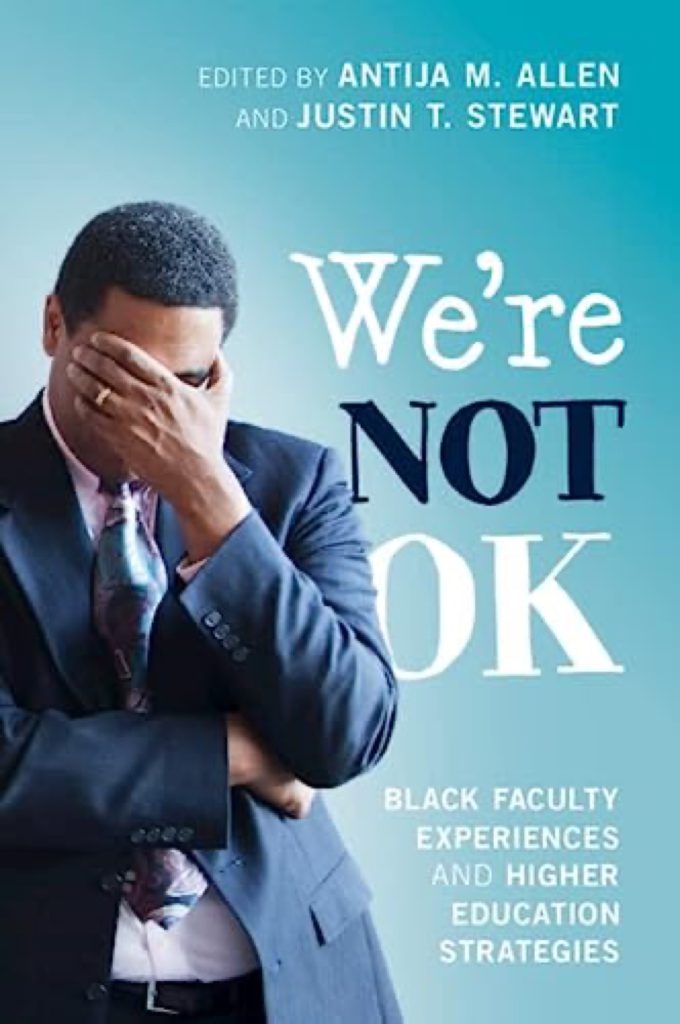
“We’re Not OK” offers strategies that support the hiring and retention of Black individuals in institutions of higher education. The book opens with statistics highlighting how few faculty members comprise Black, Indigenous and people of color. Each chapter thereafter introduces a different dynamic to the Black experience in higher education as a faculty member and is categorized into three subgroups:
The transitional experiences of Black students to faculty
The preservation and promotion of mental well-being for Black faculty
The strategies designed to aid in the retention of Black educators
Additionally, the authors suggest approaches that address the primary issue presented in their respective chapters. For instance, HR departments are encouraged to reconsider their hiring practices, with suggestions to allow Black faculty members to lead hiring committees as opposed to merely being invited to sit on them. Recommendations also include requiring departments on college campuses to hold white students, faculty and staff accountable for the microaggressions they display. The strategies are all practical and offer sufficient detail for replication. Yet, some tactics are ambiguous, such as advocating for Black faculty members to have the right to say no. Even still, many more strategies shared are geared toward administration. As such, the contributor suggestions all require a systemic change to occur, not working to increase the skills of those attracted to higher education. The suggestions are less focused on enhancing the knowledge base and preparation of prospective Black faculty members. Another missing component is the Black faculty experiences at an HBCU, as the focus tended to be solely on PWIs (predominantly white institutions).One feature of this book is its 19 contributing authors. Yet only brief biographies are offered for the two editors, Anjita M. Allen and Justin T. Stewart. Allen serves as CEO of an organization she founded that guides individuals seeking employment as faculty in higher education. Additionally, her resume details two decades of experience as a postsecondary educator. Stewart works alongside Allen in the role of chief operating officer and a consultant offering coaching strategies to those interested in becoming faculty in higher education or growing professionally in academia. Interestingly, although some sections read as a journal entry or with a conversational tone, others use the template for most methodology-based scholarly writing. Yet, there is still a cohesiveness to what is shared. This is likely a direct reflection of the fabric of familiarity that comes with the Black plight. The information shared in this anthology is pertinent and could be helpful for those in positions as department heads, university presidents and other influential stakeholders. Those who are seeking teaching roles in postsecondary institutions may find relevancy primarily in the accrual of knowledge and the affirmation the statistical data provides.
First published in Black Mental Health Today, Summer 2023 (Vol. 8).