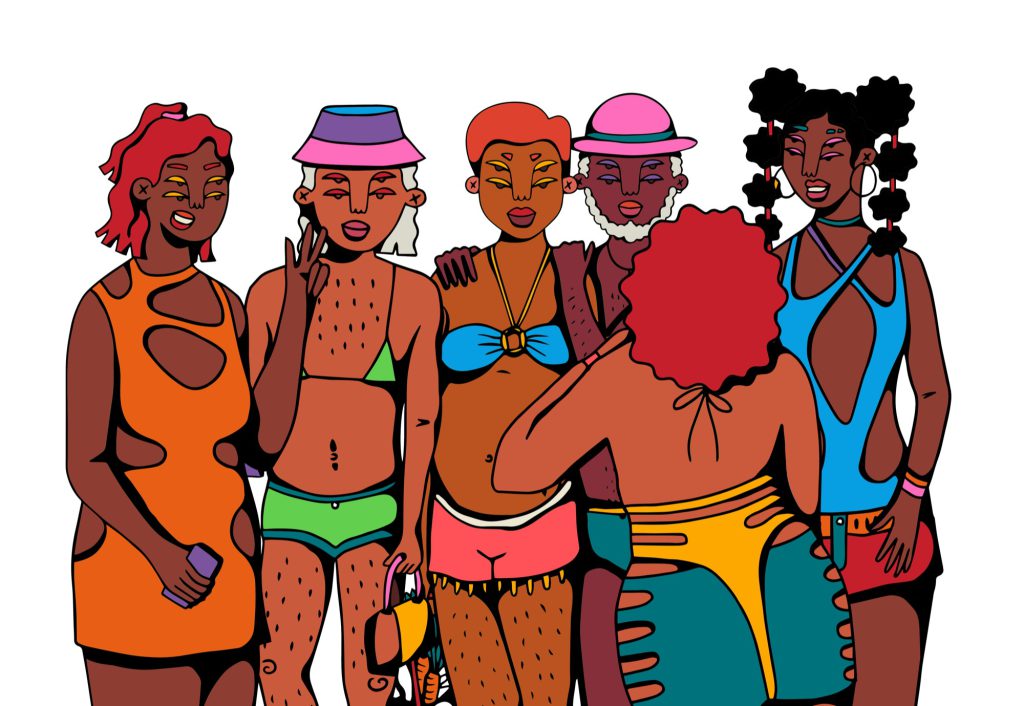
When you look at most relationships within the Black community you see cisgender, heterosexual, monogamous couples. This often makes it difficult for people to understand that’s not the only way people show up in loving relationships. Monogamy is what we’ve learned growing up. It’s what we know to be the “right” way to have a relationship. Most of this comes from our belief systems and the religious teachings that we learned growing up. Not to say that all individuals who are Black are also Christians, but there is a good representation amongst our people – who are black Christians – adhering to this belief. I always say monogamy is the default relationship style and we do not know anything different, therefore, we do not engage in anything different. Polyamory in its most simplistic form means “many loves, ” or to have the capacity to love more than one. A key aspect of polyamory is honest connections that are consensual among all parties. The level of involvement or dynamics – open, meaning there’s room for others; closed, meaning the opposite – varies from relationship to another. Knowing you can have meaningful and powerful connections with multiple people simultaneously can bring about a new sense of freedom. This appears to be a huge shift in the mindset of the younger generations. The stigma of being poly is not one that appears to be as heavy in the Black youth today. This could also be because of the LGBTQ+ population having a large correlation with non-monogamy. Some of the things people say when they discuss polyamory in the black community:
“You just have low self-esteem, or don’t know your worth.”
“You’re stupid and have been brainwashed.”
“Better you than me. I’m too jealous for that.”
“I’m not sharing my partner with nobody.”
“Why do you want to do that?”
According to Ruby Bouie Johnson, a licensed clinical social worker and founder of PolyDallas Millennium, a symposium about consensual and ethical nonmonogamy, “Black polyamorous couples tend to have concerns around what other people will think or say when they find out that they’re polyamorous.”It is often assumed there’s no possible way someone has freely “chosen” this type of relationship. There have been recent discussions about this being a sexual-orientation identifier as well. Understanding that our people are more open to new ways of doing things, including relationships, is helpful. Being in spaces where judgment and condemnation aren’t the first go-to can improve mental health outcomes in Black communities. Couples who are non-monogamous need and deserve the same opportunities to address their mental health and relationship concerns. They desire to have clinicians they don’t have to “teach” but can provide adequate help. As a mental health professional, I think it is important to ensure we have the knowledge and skill set to assist Black couples and individuals as it relates to nontraditional relationship and love styles. When we don’t, it’s extremely important to have safe and affirming places to refer them to.
First published in Black Mental Health Today, Spring 2022 (No. 3).