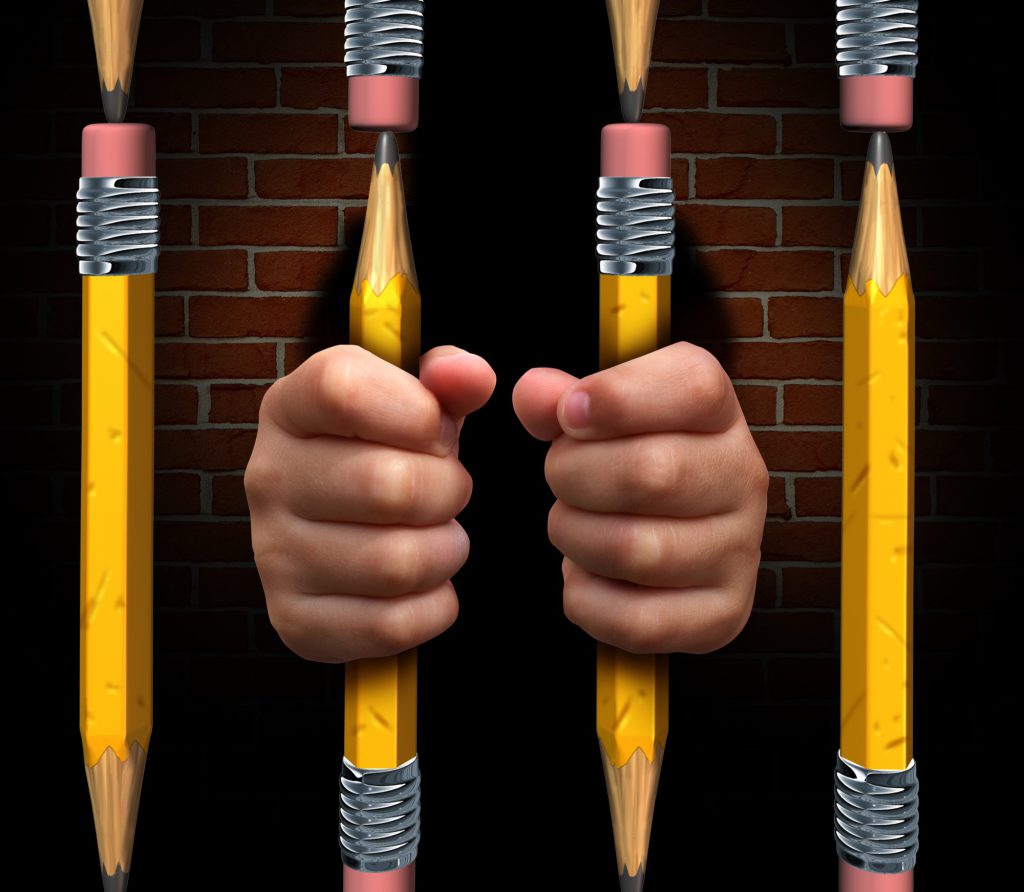
It has been more than four decades since researchers first raised concerns regarding disproportionately high rates of school suspension for Black students compared to their white peers. At the time, the rate of Black youths getting suspended from school was about 6%. In the years since, that racial gap has only gotten bigger, and public schools’ approach to punishment has grown more aggressive, employing a zero-tolerance policy for breaking school rules. By 2014, Black students were three times as likely to be suspended as white students, starting as early as preschool. Missing that much time in class not only affects students’ mental health, stability and social connection, but also, often, the trajectories of their entire lives. Black youths have increasingly gone from being students with homework assignments to inmates with criminal records. This is the school-to-prison pipeline, a dynamic that Clinique Chapman, associate director of the Restoring Promise initiative at the Vera Institute of Justice in the D.C. Metropolitan area, calls a “crisis.”The pipeline, she says is “the manifestation of systemic inequalities in the ways in which our schools are policed.” “Our children aren’t (allowed) to remain children for very long. There’s this disproportionality between the rate at which Black children – especially those from underserved neighborhoods and schools – find themselves in prison. Our youth are having … life-altering contact with the justice system. The education system really holds a great deal of responsibility.”The pipeline, says Bettie Ray Butler, is “the parallel between the educational and juvenile justice system where Black students and Black youth are being targeted, more or less for subjectively defined offenses.” Butler is associate professor of Urban Education at UNC Charlotte in North Carolina. She also serves as the university’s program director of the Master’s of Education (M.Ed.) in Urban Education. “It’s pushing them into either the juvenile justice system or to incarceration. It’s detrimental to their lives and to their futures.”The school-to-prison pipeline is a systemic problem encompassing education, criminal justice and policy. But there are ways parents can be proactive and advocate for their children. Likewise, for mental health professionals, how they approach the youths and families they work with can enhance their efficacy, and potentially help curb the pipeline itself. Being part of a team Chapman and Benton suggest that parents think of themselves as part of a team that advocates for their child at school. Sometimes a power dynamic can emerge, in which teachers and administrators make decisions about a child in the absence of context or information about them. Being proactive as a parent can start before a child even attends school. Chapman recommends seeking out third-party evaluations and opinions about any school before enrolling their child. That can help families feel empowered from the get-go, instead of feeling like victims of a system that, she says, “weren’t designed for the success of Black children and people of color.”
Once parents pick a school, says Butler, the start of the academic year is a good time to reach out to a child’s teacher and share information about their specific needs and family context. For example, in what type of environment does a child thrive? Are there tools, like technology or books, with which a child does their best work? Are there behavioral accommodations that should be made? Finally, are there aspects of the child’s family background or circumstances that would help inform a teacher about that child? “Advocacy,” she says, “starts with communication, bottom line.”After the school year begins, Butler and Chapman say, continuing to be present in the child’s life at school is also important. Being present, however, can mean different things to different parents and, ideally, teachers and administrators are flexible, too. That means sharing a cell phone number and telling a teacher the best way to contact them, which might be a text message instead of an email. That could mean asking to attend PTA meetings over Zoom. “It’s important that communication is clear and demonstrates that your child is loved and has a community behind them,” says Chapman. “You never want them to feel like they’re advocating for themselves.”How mental health professionals can help The ways a mental health professional approaches systems, students and parents is crucial. They’re working at macro and micro levels and, says Chapman, so it’s important to think about both.
At the macro level, Chapman encourages mental health professionals to question and challenge the system in which they’re working, and to do so through the lens of racial equity. Is the system, she says, one that is anti-racist? How is the system working for all children, not just those on our caseload? Is the school’s disciplinary policy actually good policy? At the micro level, Butler and Chapman agree that creating space for open discussion about a conflict and giving each person in the meeting a voice is important. In the criminal justice setting, that approach is restorative justice. In school settings, Butler encourages what she calls restorative practices. In all cases, says Chapman, all participants are addressing conflict through the lens of harm and healing the harm. The key to that is avoiding a one-size-fits-all approach. “Some folks (are) looking for a silver bullet,” says Butler. “I push back a little bit because there is no silver bullet there. There are no direct strategies. Everything is context-specific. “They’re asking, ‘What’s happening here, in this situation?’ ‘What are the unique details of this situation?’ And then they identify and co-construct solutions with the parents: ‘What is it that you need?’ And then using their professional judgment to offer what is deemed appropriate.”“The (mental health professionals) that I’ve seen do this well. They know the community, and they know the community well. They are really the liaison between the parents and the students and the school. They’re connecting folks, building this web of community.”Focusing on solutions Amid swaths of research about the school-to-prison pipeline, there are also myriad ways to focus on solutions. The way forward that Butler and Chapman recommend relies on mutual respect, communication and context. An open framework, said Butler, offers a voice to everyone: parents, students, teachers, and sometimes other students involved in a disciplinary action. For Chapman, it’s in that space where communication can happen, and parents, students and mental health professionals can have difficult discussions and, ultimately, reckon with the past. “It’s (about) having hard conversations in the face of adversity,” she says. “We need culture change within our schools. Culture change requires uncomfortable conversations. And being OK with that, not running from that. Because that’s where progress will be.”
First published in Black Mental Health Today, Spring 2023 (Vol. 7).